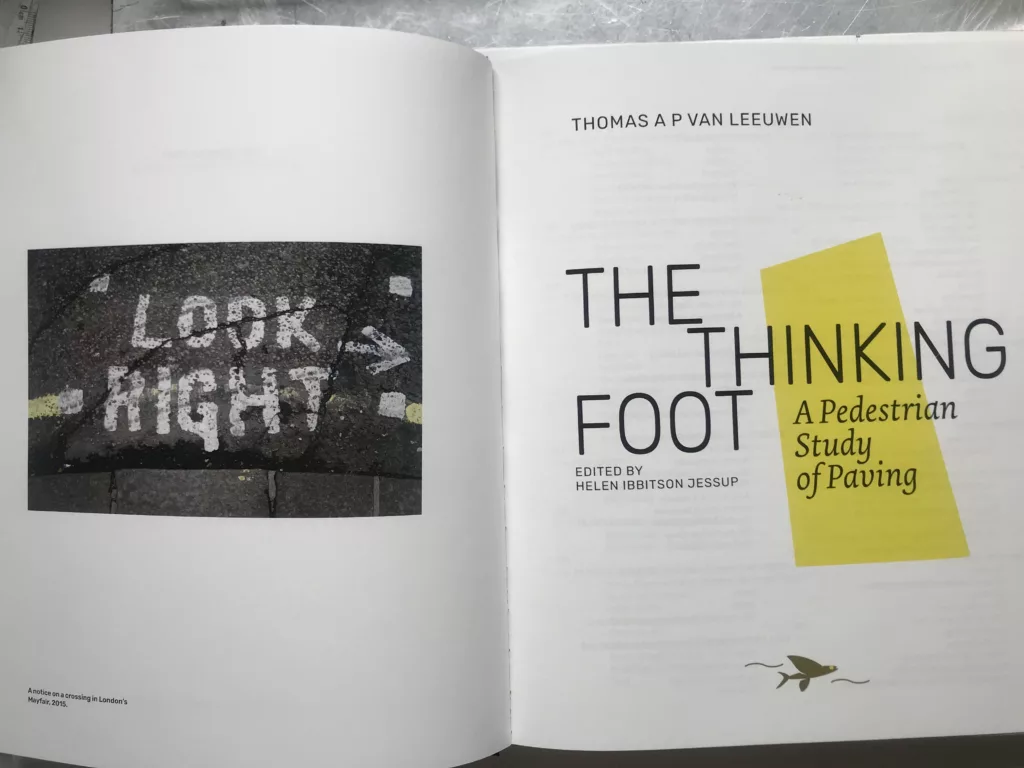
THE THINKING FOOT – A PEDESTRIAN STUDY OF PAVING
BY THOMAS A P VAN LEEUWEN
Edited by Helen I. Jessup
Designed by Eliane Beyer – Joseph Plateau – Amsterdam
The Thinking Foot is a study of history and associations. In method and form it claims to be no more (nor less) than an illustrated essay on the architectural expression of surface. It concentrates on the Earth on which we walk: not the Earth in depth (the underground world) nor the geological Earth, but simply the Earth as visible crust, as surface. The Thinking Foot is indeed about surface and in particular about how this surface was made into a ‘civilized’ theatre of communal existence. Civilization means turning things, mostly private or wild, into communal or civic use. Untreated surface becomes communal ground through paving. Paving has many qualities. It hardens the ground, it hides the ground, it equalizes the ground and it protects the ground. Aesthetics certainly play an important part in its appreciation, but on the whole paving is intended to be practical; the intention of paving is to be practical and useful. Throughout its evolution paving has proved to be a necessity with very little artistic ambition and almost no depth. It is surface, just that.
Date of publication:15 November 2023


- Review by Gary Schwartz, luminary of art history and foremost Rembrandt scholar for Amazon Books.UK August 2025
- “Thomas A.P. van Leeuwen is blessed with oblivious disregard for all the boundaries and restrictions that keep writers in the humanities divided into “fields” – call them corrals. He prances freely across any and all disciplines where he finds nourishment to feed his curiosity – not sate it, since his curiosity is insatiable. In this unique book he infects the reader with something of the same. While reading it, and ever since, I have developed a sense I never knew I had for the nature and quality of the contact between my feet and the ground. Van Leeuwen insists, and he is right, that every instance of such contact has a character of its own. I now know that the ground that I have always taken for granted is the product of factors in society, politics, technology, public health concerns, city-planning, all their histories, and more, impacting differently on everywhere in the inhabited world. I now look at the materials, the patterning and the maintenance of the pavements on which I walk, and marvel at how much I have not been looking at or thinking about until now.
The wealth of this book is impossible to sum up in a brief review. To give an idea of its depth and scope, here are the subjects of chapter XI, “Streets and Trottoirs:” “The Street. Pedestrian Domain. Paris and its Trottoir. The First Trottoir. A Note on the Umbrella. London and its Pavement. The Dublin Paving Board. The Amsterdam Stoop. The London Square.” That is for starters.
Any conscientious pedestrian, and shouldn’t we all be that, will be robbing himself of insight into and the pleasure of knowing about, his own interaction with the everyday earth, without reading The Thinking Foot. Admirers of The Thinking Foot will be thrilled to know that it is “the final volume of a tetralogy exploring the relationship between architecture and the classical elements: Air, Water, Fire, and Earth.” There is little that is not grist for the mill of the prodigious Thomas A.P. van Leeuwen.” - Now available at : https://www.japsambooks.nl/collections/nieuwe-titels?page=1
And all major bookshops. History, Design, Architecture, Urbanism and Cultural History.
Thomas A P Van Leeuwen, The Magic Stove: Barry, Soyer and The Reform Club or How a Great Chef Helped to Create a Great Building.

This little book –ninety-one pages and fifty-six illustrations- with the lengthy title The Magic Stove: Barry, Soyer and The Reform Club or How a Great Chef Helped to Create a Great Building explores the architecture and technology of the London Reform Club, a noted but generally misinterpreted work of Charles Barry, Britain’s most famous unknown nineteenth-century architect. Barry’s fame is mainly based on the Houses of Parliament, his best known work. In fact, they are much more than just “known”, they are so famous that there is hardly another building in the world that has the same emblematic status. They appear in films, in news presentations, on postage stamps, in picture postcards and in almost anything that proclaims: “this is Great Britain”. Equally famous, but more in the transient way of a modern celebrity, and certainly not “known” is Highclere Castle, the notorious emplacement of the globally viewed television series Downton Abbey. A greater fame is hard to achieve and Charles Barry was the architect. The scale on which Barry worked, the sheer number and size of the projects, is staggering. Even during the period he was chief architect of the Parliament buildings, he had found time to design one of the grandest of London club houses–also functioning as location for (block-buster) films and documentaries-the Reform Club (1837) on Pall Mall. So much work in a limited time span had proven to be too much for the great man. He died at an early age, 65 years old, of exhaustion.
Still, as is so often the case, popular artists are seldom respected, let alone admired, especially not by those who had made it their business to know about architecture. Proof of this deplorable fact is that no serious or even non-serious monograph of Barry exists. Barry was not an innovator, one so believed, or an artistic architect, and thus was not worth exploration. But appearances are deceptive. Although from the outside The Reform Club building looks traditional and all too formal, once inside an exciting world unfolds of light and technological innovations. Especially the kitchen, designed by the Club’s chef-de-cuisine Alexis Soyer, drew large crowds at the time of the opening in 1841 and was the talk of the town. For the first time gas was introduced as the source of heating, rather than light, the kitchen machinery was driven by a steam engine and experiments with forced ventilation were attempted.
In this elegantly presented and richly illustrated study, attention is given to the building as a social and technological system. César Daly, contemporary of Barry and architectural critic was fascinated by the inner workings of the building, which he compared to “almost a living being” (“presque un corps vivant”).
Many rare and unpublished illustrations, thirty-four out of fifty-six in colour, help to underpin this argument.
First edition: 2017.
Second revised edition: 2020.
Now available at: https://www.japsambooks.nl/collections/nieuwe-titels?page=1
Earlier essays by Thomas A P on Soyer, Barry and The Reform Club have appeared in Cabinet Magazine issue 37, 2010, “Hot on the Trail”. http://www.cabinetmagazine.org/issues/37/vanleeuwen.php and Hunch no 13, 2009 “The Magic Stove”.